Analysis of Nigeria’s Social‑Security Situation in August 2026
Researcher 007
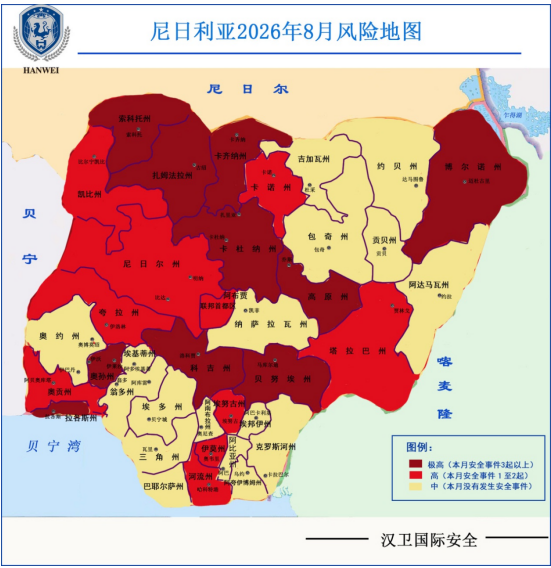
Based on monitoring reports from Hanwei International’s West‑Africa‑based security officers and comprehensive media coverage, a total of 76 security‑related incidents were recorded in Nigeria in August 2026. These incidents claimed the lives of 390 civilians and 22 military‑police personnel, with at least 261 persons abducted. Major incident categories included armed assaults and kidnappings, demonstrations and violent clashes, ethnic conflicts, military counter‑insurgency sweeps, and public‑safety accidents. Compared with the previous month, the number of incidents rose by 13, fatalities increased by 97, and abduction cases went up by 170. Analysis shows that August saw a substantial surge in the volume of security incidents, casualties and abductions across Nigeria, reflecting overall deterioration of the security landscape. Of particular note was the mosque attack in Niger State on 21 August, which killed 30 people and abducted more than 60; the incident drew widespread international condemnation and triggered domestic protests demanding that the government improve security conditions. In response, Nigerian President Tinubu directed the military, police and relevant security agencies on 25 August to launch coordinated operations to track kidnappers and rescue victims. During this month, central, north‑eastern and north‑western Nigeria faced extremely high security risks, while other regions were rated medium‑to‑high risk.
I. Comprehensive Analysis of Security Incidents
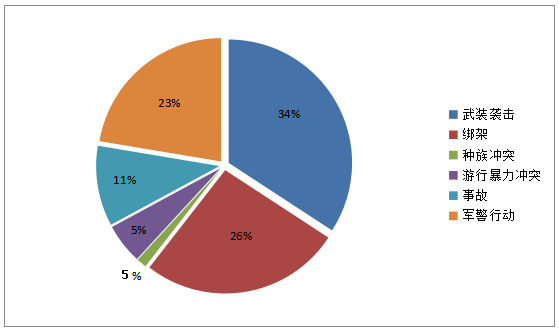
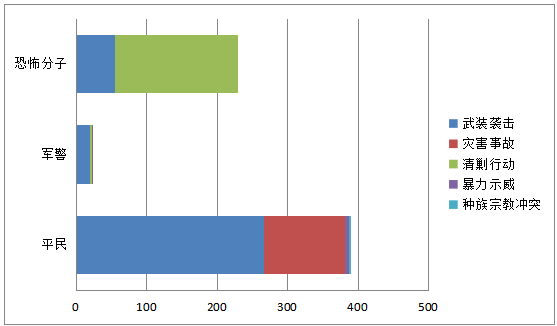
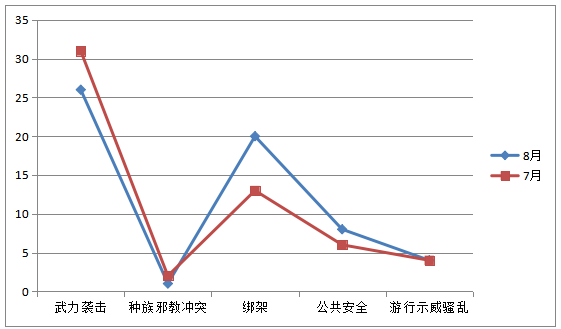
The 76 security incidents recorded in Nigeria for August comprised 26 armed assaults (34 %), 20 armed kidnappings (26 %), 1 ethnic‑religious conflict (1.3 %), 4 demonstrations‑turned‑violent (5.2 %), 8 public‑safety incidents (10 %), and 17 military counter‑insurgency operations (22 %). Cumulatively, these events caused 644 fatalities and at least 261 abductions. Among the fatalities were 390 civilians, 22 military‑police personnel, and 232 killed terrorists. Key features of the overall security situation are outlined below:
(I) High‑Risk Zones Concentrated in the Northwest, Central and Northeast
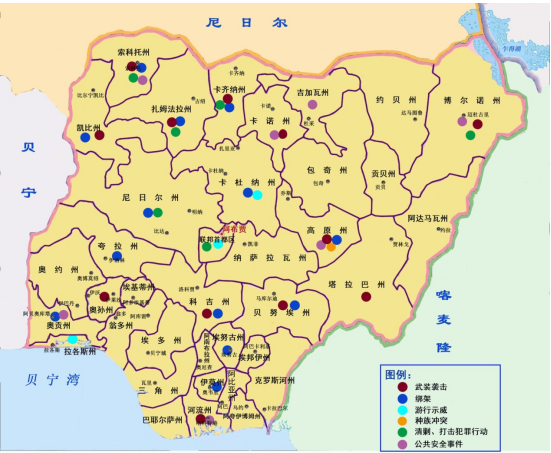
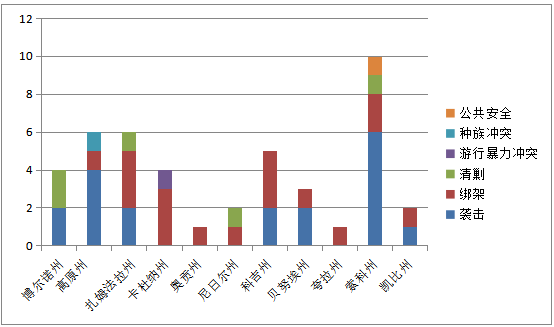
Security incidents in August were heavily concentrated in Sokoto and Zamfara States in the northwest. High‑risk areas also included Benue and Plateau States in central Nigeria; Borno State in the northeast; as well as Kaduna and Katsina States in the north‑central zone. Sokoto State in the northwest registered the highest threat level, with 10 security incidents (mainly armed assaults, kidnappings and public‑safety accidents) resulting in 174 deaths and 41 abductions. Zamfara State (north‑west‑central) and Plateau State (central) each recorded 6 incidents dominated by armed assaults and kidnappings, causing 13 / 37 deaths and 126 / 2 abductions respectively. Beyond frequent armed raids and abductions, Zamfara State’s security environment grew more volatile as armed groups persistently extorted “protection fees”. In early August, a new local armed‑group commander ordered every village within the Chafi Local Government Area to pay 200 000 Naira for weapons procurement, failing which new armed attacks would follow. Local residents reported that alongside ransom‑driven kidnappings, militant factions imposed so‑called “protection fees” or “weapon taxes” on rural communities. Villages refusing payment faced threats of arson, abduction and even mass killings. Such activities severely undermined local economies and agricultural production, displaced large populations and deepened the humanitarian crisis across north‑western Nigeria.
In mid‑August, the United Kingdom issued travel‑security advice recommending avoidance of 11 Nigerian states including Borno in the northeast, and Katsina and Zamfara in the northwest. The advisory noted mounting threats from Boko Haram and Islamic State West Africa Province (ISWAP) in the northeast; routine military operations in Adamawa, Borno and Yobe States risked triggering retaliatory strikes. The northwest suffered rampant banditry and violent assaults with extreme kidnapping risks, especially within Zamfara, Katsina, Kaduna, Borno and Sokoto States. Elevated kidnapping risks also persisted across central‑southern states such as Niger, Kogi, Kwara and the Federal Capital Territory of Abuja.
Figure 1: Schematic Map of Security‑Incident Distribution – August
Table 1: Statistics of Security Incidents by Major Region – August
(II) Rampant Armed Assaults and Kidnappings Gravely Undermine Livelihoods and National Interests
A total of 46 armed‑assault and kidnapping incidents took place in August, killing 290 people and abducting at least 261 victims. Compared with July, incident numbers rose by 2, fatalities increased by 83, and abductions climbed by 170. Major casualty‑producing events included:
Morning of 1 August: Bandits raided a village in Sabon‑Birni Local Government Area, Sokoto State, leaving no fewer than 12 dead.
Night of 3 August: Armed bandits attacked the Chamaye community within Sabon‑Birni Local Government Area, Sokoto State; at least 21 were killed, 37 abducted, thousands fled, houses were burned and livestock looted.
10 August: An armed strike in Sakaba Local Government Area, Kebbi State killed 10 police officers and 2 civilians, wounding 2 policemen.
13 August: Successive armed ambushes along the Rafin‑Kada‑Ukaru highway within Ukaru Local Government Area, Taraba State caused 11 fatalities.
14 August: A community in Sokoto State (north‑west Nigeria) came under armed assault; at least 32 people died, numerous houses and vehicles were burned, and large‑scale civilian displacement ensued.
15‑17 August: Repeated bandit raids targeted the Unguwar Guru community in Kankia Local Government Area, Katsina State; 13 fatalities were recorded, multiple women and girls were abducted, and over 3 000 residents fled.
16 August: Alleged armed herders assaulted multiple communities in Mbatarem, Ukum Local Government Area, Benue State, killing 22 and wounding many. That same night, suspected bandits struck the Ungush community in Kebbe Local Government Area, Sokoto State, causing at least 22 deaths.
18 August: An armed attack in Plateau State (central Nigeria) killed approximately 30 people and inflicted severe injuries on many others.
21 August: Militants stormed a mosque in Niger State (central Nigeria), killing 30 worshippers and abducting 60.
Analysis indicates that August’s volume of armed assaults and kidnappings, together with associated casualties and abduction figures, exceeded July levels and posed severe threats to national livelihoods. Early in August, senior United Nations counter‑terrorism officials designated Islamic State West Africa Province (ISWAP) in north‑eastern Nigeria as the world’s most active ISIS affiliate. Its operatives skilfully leverage artificial intelligence, encrypted communications, virtual assets, drones and other emerging technologies to expand influence, recruit new members, cross‑regionally channel funds and supplies, and even plot trans‑national terrorist attacks. The UN warned that Sahel‑based terrorist groups no longer aim merely to destabilize local governance; they may pose direct security threats to Nigeria and neighbouring countries. Sustained armed raids and abductions also sparked humanitarian crises including disruptions to education. Nigerian‑media reports dated 9 August stated that at least 65 primary and secondary schools across northern Nigeria were forced to close or suspend operations due to terrorist assaults, abductions and community displacement, denying tens of thousands of children access to schooling. Within Sokoto State, schools in 20 out of 23 local‑government areas were shut indefinitely. Thirty‑five primary schools in Benue State were affected, with teachers and pupils fleeing and instruction halted entirely. Mass school closures also occurred in Borno State. According to a recent assessment by the International Organization for Migration (IOM), roughly 737 000 internally displaced persons resided in north‑western Nigeria; approximately 620 000 (84 %) were forced from home by banditry and kidnappings.
Reported kidnapping statistics likely understate real‑world prevalence. Released 26 August, the Panorama Report on Nigeria’s Kidnapping Economy documented 1 411 kidnapping incidents nationwide between July 2025 and June 2026, with a cumulative 7 825 abducted persons. States severely afflicted by kidnapping included: Benue (32 incidents, 145 abducted, 15 fatalities); Kebbi (52, 216, 36); Kwara (89, 265, 63); Kogi (85, 412, 21); Niger (68, 496, 54); Katsina (187, 559, 107); Kaduna (134, 814, 130); Borno (55, 892, 37); Sokoto (179, 1 157, 170); Zamfara (236, 1 921, 221). Over this one‑year period, kidnapping perpetrators demanded a total of 22.86 billion Naira in ransom payments, with 7.78 billion Naira actually received, representing a sharp upward trend.
(III) One China‑Related Incident Recorded
One China‑relevant security event occurred in August: three Chinese nationals were arrested for illegal fishing. On 30 August, the Nigerian Navy jointly with the Federal Ministry of Fisheries and Aquaculture conducted law‑enforcement operations and detained 33 trawler crew members engaged in illegal, unreported and unregulated (IUU) fishing. The detainees comprised 3 Chinese citizens, 2 Ghanaians and 28 Nigerians. All arrestees have been transferred to Lagos Defence Jetty and will face further investigation and judicial proceedings in accordance with local laws.
(IV) Major Casualties Caused by Public‑Safety Incidents
In August, incomplete statistics recorded 8 major public‑safety incidents across Nigeria, resulting in 115 deaths – an increase of 59 fatalities month‑on‑month. Incident types included traffic collisions, building collapses and boat sinkings. Two vessel‑capsizing disasters produced heavy loss of life: a boat accident in Sokoto State (north‑west Nigeria) on 20 August killed 53 people; on 23 August, a canoe capsized within Ringim Local Government Area, Jigawa State, claiming at least 30 lives.
Major disease outbreaks persisted nationwide. Lassa‑fever incidence moderated yet continued spreading across multiple states. Latest figures from the Nigeria Centre for Disease Control (NCDC) as of 2 August showed 7 135 suspected cases, 1 017 confirmed cases and 239 deaths across 117 local‑government jurisdictions in 23 states, yielding a case‑fatality rate (CFR) of 23.7 %. Compared with July, suspected cases rose by 581, confirmed cases by 54 and fatalities by 10. Cholera spread further: official Borno State data as of 1 August surpassed 35 000 suspected cases and 198 deaths. The epidemic has spilled into Yobe, Bauchi and Plateau States; 16 cholera‑related deaths have been confirmed in Bauchi. Diphtheria outbreaks also struck Kano and Plateau States. Kano State authorities announced on 25 August that diphtheria had killed no fewer than 50 children. On 30 August, Plateau State’s Health Commissioner reported 143 suspected diphtheria infections and 23 deaths over the preceding two‑week period.
(V) Escalated Military Counter‑Insurgency Operations
Nigerian military‑police forces intensified nationwide counter‑insurgency sweeps in August: 232 militants were killed and nearly 500 abductees rescued. On 8 August, the Nigerian military announced it had freed 363 hostages, killed 69 terrorists and apprehended 49 suspects within a single week. Between 12‑13 August, anti‑terrorist missions across multiple states yielded large numbers of militant arrests. The Joint Task Force‑North‑West launched Operation Sweep IV, combining ground manoeuvres and air strikes to intensify pressure on terrorists and armed criminal gangs; dozens of militants were eliminated. On 14 August, the Nigerian Navy rescued 22 passengers held by maritime gunmen within Akwa‑Ibom State waters. On 22 August, troops under Operation Hardin‑Kai executed multiple precision‑airstrike sorties across parts of Borno State, killing approximately 38 terrorists.
Table 2: Breakdown Comparison of Security Incident Categories – August
Table 3: Statistical Breakdown of Fatalities by Group – August
Table 4: Comparison of Major Security‑Incident Volumes: August vs July
II. Risk Early‑Warning & Mitigation Recommendations
Table 5 Short‑Term Early Warning of Nigeria’s Social‑Security Risks
Risk Level Definition & Score Regions and Cities Hazard Sources Extreme Risk Level 1 (17‑25 points) Grade Ⅰ (23‑25 points) Borno State, Zamfara State and other states in the Northeast and Northwest Terrorist attacks by Boko Haram extremist group, ethnic vendettas, military counter‑insurgency operations Grade Ⅱ (20‑22 points) Middle‑Belt states including Kaduna, oil‑producing states in southern Nigeria Ethnic conflicts, armed factions of the Movement for the Emancipation of the Niger Delta, kidnapper hostage‑taking, etc. Grade Ⅲ (17‑19 points) Offshore waters of southern states such as Rivers State (Gulf of Guinea) Pirate attacks, armed abductions, theft, etc. High Risk Level 2 (10‑16 points) Grade Ⅰ (15‑16 points) Ogun State, Oyo State, Osun State, Anambra State and other areas Hostage‑taking, sporadic terrorist attacks, etc. Grade Ⅱ (13‑14 points) Abuja, Lagos, etc. Protest demonstrations, armed kidnappings, theft, etc. Grade Ⅲ (10‑12 points) — — Medium Risk Level 3 (5‑9 points) Grade Ⅰ (8‑9 points) — — Grade Ⅱ (5‑7 points) — — Low Risk Level 4 (1‑4 points) Grade Ⅰ (3‑4 points) — — Grade Ⅱ (1‑2 points) — — Note: Internal security risk assessment of Hanwei International
Given Nigeria’s complex social landscape and high‑risk security ratings, the following protective measures are advised:
Deploy round‑the‑clock security support for travel. Remote rural areas suffer thin police coverage and poor road infrastructure; security‑force response times for violent crime and civil unrest are frequently protracted. Chinese‑funded enterprises should source up‑to‑date local security intelligence, conduct site‑specific risk assessments prior to trips, and arrange for professional security escorts during movements.
Heighten vigilance amid election‑cycle risks. Official campaigning for Nigeria’s 2027 general election commenced on 19 August. Electoral periods bring elevated uncertainty and potential for armed assaults and communal violence. In August alone, 5 recorded attacks targeted legislators or government officials, causing 4 deaths and 1 abduction. Chinese‑run entities and nationals in Nigeria are advised to steer clear of protest‑rally venues to guarantee personal safety.
Effectively evade hazards. Most attacks occur in the north‑east and north‑central zones, notably central Maiduguri (Borno State), inter‑town highways, Niger‑border frontier zones, and Zamfara State. Kaduna State and Abuja have also seen frequent recent security events. If caught in a terrorist‑attack scenario, comply with official directives, liaise with contracted security providers for timely assistance. Install closed‑circuit‑television surveillance at compounds, business premises, warehouses and residences. Fortify camps with trenches, high perimeter walls, barbed wire, anti‑vehicle barriers, buffer zones and alarm systems; augment military‑police security detachments and extend defensive perimeters. Avoid lingering near potential armed‑attack targets including government‑security‑force installations, landmark buildings and religious sites. Minimize dwell‑time within high‑exposure public spaces: north‑eastern locales, religious‑festival venues, multi‑ethnic mixed zones, crime‑prone roadways (especially highways and pirate‑plagued Gulf‑of‑Guinea waters), oil‑and‑gas facilities, government/military compounds, diplomatic missions, worship centres, schools, marketplaces, refugee settlements, transport hubs and surrounding vicinities.