Analysis of Nigeria’s Social‑Security Situation -July 2026
Researcher No. 007
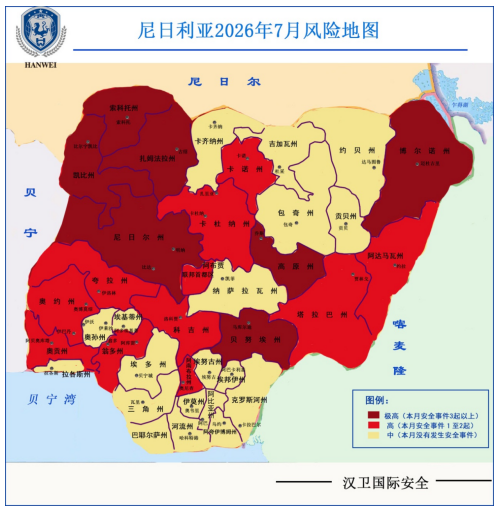
Based on monitoring reports from Hanwei International’s West‑Africa security officers and comprehensive media coverage, 63 security incidents were documented across Nigeria in July 2026. These incidents killed 308 civilians and 7 military‑police personnel, with at least 91 persons abducted. Major incident categories included armed assaults and kidnappings, demonstrations‑turned‑violent, ethnic clashes, military counter‑insurgency operations and public‑safety accidents. Compared with the previous month, the number of security incidents fell by 10 and abductions dropped by 112, yet fatalities rose by 67. Analysis shows that although July recorded fewer security incidents and abductions, casualties increased substantially with higher death tolls than June, and the overall security situation remained severe. In response to Nigeria’s continuous security deterioration, President Tinubu announced military expansion on July 23: four additional divisions and 28 000 new recruits together with higher defence budget to tackle mounting domestic security threats. Extremely‑high security risks prevailed in central, north‑eastern and north‑western Nigeria; other regions faced medium‑to‑high risks.
I. Comprehensive Analysis of Security Incidents
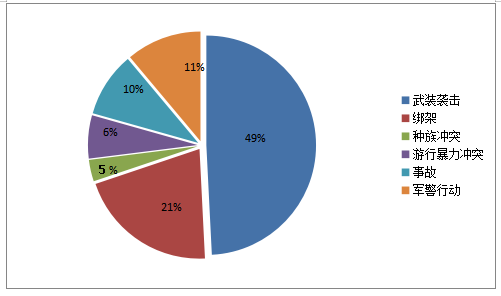
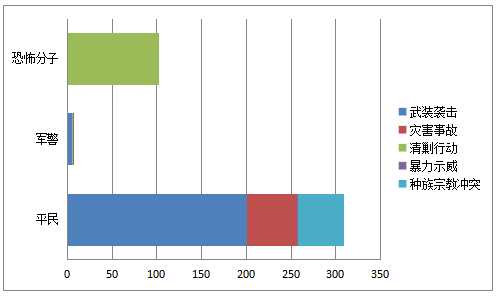
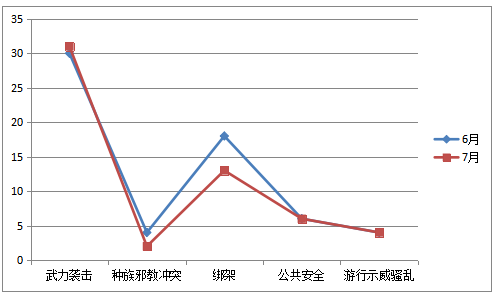
The 63 recorded security incidents in July broke down as: 31 armed assaults (49 %), 13 armed kidnappings (20 %), 2 ethno‑religious clashes (3.1 %), 4 violent demonstrations (6.3 %), 6 public‑safety accidents (9.5 %), and 7 military counter‑insurgency operations (11 %). Combined, these events caused 417 fatalities and at least 91 abductions. Fatalities comprised 308 civilians, 7 military‑police personnel and 102 killed terrorists. Key features of the security situation are set out below:
(I) Extremely‑high‑risk zones in Central, North‑West and North‑East
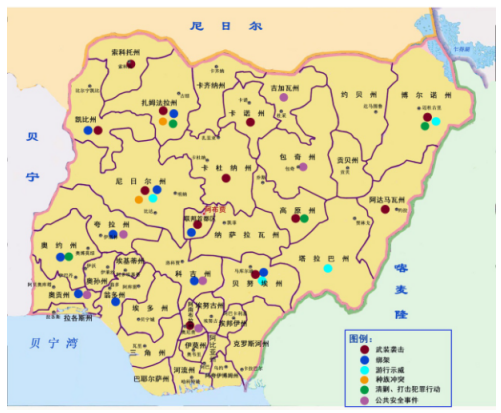
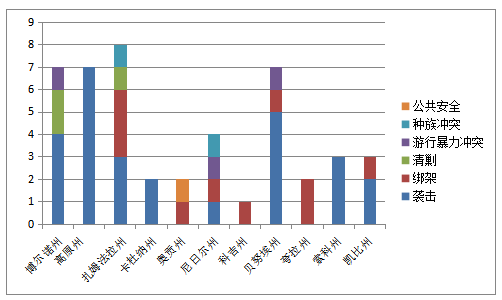
In July, security incidents clustered mainly in Benue and Plateau States (Central), Borno State (North‑East), and Zamfara State (North‑West). Additional high‑risk jurisdictions included Kaduna and Niger States (North‑Central), as well as Kebbi and Sokoto States (North‑West). Zamfara State in the North‑West registered the highest risk level, with 8 incidents (predominantly armed assaults and kidnappings), one more than June, causing 85 deaths and 52 abductions. Borno, Plateau and Benue States each recorded 7 security incidents, mostly armed attacks and abductions, with 8, 18 and 35 fatalities respectively. Benue State, located at Nigeria’s north‑south transition zone, saw a sharp rise of 5 additional armed assaults month‑on‑month. This stems from overlapping pressures over land, pasture, water resources and population growth, which deepened frictions between farming communities and nomadic herders and fuelled armed violence and criminality.
Early this month, the Security‑Operations Office of the Chinese General Chamber of Commerce in Nigeria issued a security early warning. It alerted that bandit groups plotted raids and abductions targeting Chinese employees in Shiroro LGA, Agata‑Amboji and other locations of Niger State. Chinese‑funded enterprises and individuals in those areas were urged to heighten vigilance over personal safety.
Figure 1: Schematic Distribution of Security Incidents in July
Chart 1: Statistics of Security Incidents by Major Region in July
(II) Persistently high levels of armed assaults and kidnappings
Armed assaults and kidnappings remained Nigeria’s primary security threat in July, totalling 44 events, causing 207 fatalities and at least 91 abductions. Month‑on‑month, incident numbers decreased by 4, deaths increased by 16, and abductions fell by 113. A defining feature was frequent attacks on agricultural villages. Besides heavy farmer casualties and large‑scale livestock looting, such strikes directly imperilled Nigeria’s food security. Incomplete statistics record 14 assaults on farms and rural settlements, accounting for roughly 31 % of total incidents.
July 3: Bandits carried out sustained raids on 30 villages in Bodinga LGA, Sokoto State, killing at least 7 people, displacing hundreds of residents and seizing over 1 000 head of livestock.
July 4: Bandits attacked farmland in Kankangi village, Birnin‑Gwari LGA, Kaduna State, killing 9 farmers and abducting multiple persons.
July 16: A community in Oju LGA, Benue State — Nigeria’s “granary state” — came under attack by suspected armed herders, forcing mass civilian flight.
Night of July 22: Unidentified gunmen assaulted a village in Kebbi State (North‑West), killing more than 20 residents and triggering mass displacement.
Afternoon of July 21: Motorcycle‑borne gunmen swept multiple remote agricultural communities across Zamfara State, shooting farmers working in fields; 24 people died and large herds were stolen.
July 23: Multiple villages in Maru LGA, Zamfara State endured successive large‑scale bandit incursions. At least 10 communities were fully evacuated and over 40 residents abducted.
Repeated assaults on farming and herding populations endanger national food security and economic stability. Media reports describe communal breakdown, mass civilian flight and whole‑village abandonment in some locales. Farmers cannot return to their fields, undermining food output and exacerbating poverty and social unrest across central Nigeria.
Amid worsening insecurity, President Tinubu unveiled large‑scale military expansion on July 23. The Nigerian Army will grow from 8 to 12 divisions with 28 000 new recruits. Force restructuring shall be completed by the end of 2026. The expanded troop strength will counter terrorism, uphold domestic stability and seek to improve Nigeria’s security landscape.
(III) Three China‑related cases
Three China‑linked security‑law‑enforcement cases occurred in July.
Two Chinese nationals arrested by NPF‑NCCC. On July 13, the National Police Force‑National Cyber‑Crime Centre (NPF‑NCCC) arrested three persons over high‑yield‑investment and cryptocurrency fraud, two of whom were Chinese citizens. The case remains under investigation.
Three Chinese nationals detained for illegal mining. On July 17, a snap inspection team in Nasarawa State apprehended multiple illegal miners at a mine site in Amba community, Kona LGA, including three Chinese nationals. Law‑enforcers seized mineral‑storage containers, CCTV equipment and other operational materials. The detainees are undergoing investigation.
Two Chinese nationals convicted. On July 31, the Economic and Financial Crimes Commission (EFCC) announced that the Federal High Court, Ikoyi, Lagos found two Chinese citizens guilty on five counts. They received five‑year prison sentences plus a fine of 50 million Naira. Convictions centred on conspiracy and unauthorised possession of export‑bound mica, copper‑bearing and lithium‑bearing minerals.
(IV) Nigeria‑United States military‑cooperation developments
Partial U.S. troop draw‑down from Nigeria. On July 2, the Commander of U.S. Air Forces in Africa stated that U.S. military operations in Nigeria had achieved success and the Islamic State’s leadership in Nigeria had been “significantly degraded”. Most of the 200 U.S. soldiers deployed in December 2025 commenced withdrawal. The U.S. side added that intelligence‑sharing mechanisms would continue and a small contingent would remain stationed in‑country.
Visit by U.S. Assistant Secretary of State for African Affairs. On July 15, U.S. Assistant Secretary of State for African Affairs Frank Garcia visited Defence Headquarters in Abuja and held working consultations with senior Nigerian military officers. Both sides exchanged in‑depth views on strengthening bilateral military collaboration and addressing emerging regional security challenges. They reaffirmed plans to upgrade defence‑sector ties and jointly counter terrorism and violent extremism across West Africa and the African continent.
(V) Multiple casualties from public‑safety incidents
Incomplete records show six major public‑safety accidents in July, killing 56 persons, 25 more than June. Incidents included traffic collisions, building collapses and boat sinkings.
July 6: Multiple road crashes across Kwara, Kogi and Ogun States killed at least 32 people and wounded many others.
July 19: A wooden boat capsized in Jigawa State (Northern Nigeria), leaving at least 6 dead and over 30 missing.
July 26: A three‑storey student dormitory block collapsed at the Federal Polytechnic, Oko, Anambra State, killing two occupants.
Multiple disease outbreaks unfolded this month.
Lassa‑fever spread across multiple states. Latest Nigeria Centre for Disease Control (NCDC) data as of July 12 recorded 6 552 cumulative suspected Lassa‑fever cases, 963 confirmed cases and 229 deaths, yielding a Case Fatality Rate (CFR) of 23.8 %. Compared with June, suspected cases rose by 902, confirmed cases by 8, and fatalities by 81.
Cholera expanding geographically. NCDC reports as of July 2 registered 2 655 cumulative national cholera cases. Borno State formed the epicentre, with 108 deaths since the outbreak began on May 1; the epidemic has reached 17 local‑government areas within the state. On July 22, Médecins Sans Frontières stated that the cholera outbreak in north‑eastern Borno State kept worsening and had caused nearly 200 deaths. The organisation attributed the ongoing spread chiefly to lack of safe drinking‑water and insufficient sanitation and medical services.
Sustained strict Ebola preparedness. Ebola continued spreading across Africa. As of July 27, the Democratic Republic of the Congo reported 3 360 cumulative confirmed Ebola cases including 1 487 fatalities. WHO Regional Office for Africa noted persistent community transmission and mounting mortality in DRC. Frequent human mobility and cross‑border movements maintain high risks of further spill‑over. Nigeria’s newly‑established special task‑force continued strengthening port quarantine, high‑risk‑flight screening and environmental disinfection to block Ebola importation.
(VI) Ongoing military counter‑insurgency operations
In July, Nigerian military‑police forces launched a new round of high‑intensity nationwide counter‑terrorism campaigns. Troops under “Operation Hadin Kai” advanced deeper into Borno State and the Lake Chad Basin to eliminate remnant militants, seal cross‑border infiltration routes, dismantle supply networks and enhance intelligence surveillance, squeezing operational room for Islamic State West Africa Province (ISWAP) and Boko Haram. Joint operations persisted in north‑eastern Borno, Yobe and Adamawa States to maintain military pressure on extremist groups. Large‑scale military strikes targeted militant strongholds across north‑western Zamfara, Katsina, Sokoto and Kebbi States. Central‑region deployments in Benue and Plateau States prioritised mitigation of communal clashes and armed assaults.
On July 31, Defence Headquarters (DHQ) issued an operational bulletin: in July security forces killed 102 terrorists and armed criminals, arrested 345 suspects and rescued 393 abducted hostages. Military operations increasingly targeted militant intelligence networks, logistics, arms supply and financing channels to degrade armed groups’ capacity for sustained activity.
Separately, the Nigerian Navy continued anti‑oil‑theft operations in southern zones, curbing expansion of local illegal‑refining networks. On July 23, the Navy reported that personnel under “Operation Delta Sentinel” uncovered 9 illegal refining sites within Bonny LGA, Rivers State. These included 23 dug‑out pits, among which 18 held approximately 104 000 litres of stolen crude oil.
Chart 2: Breakdown of Security‑Incident Categories, July
Chart 3: Statistical Breakdown of Fatalities by Category, July
Chart 4: Comparison of Major Security‑Incident Counts: July vs June
II. Risk Early‑Warning & Mitigation Recommendations
Chart 5: Short‑Term Social‑Security Risk Early Warning for Nigeria
Risk‑rating definitions & scoring
表格
| Risk Level | Score Band | Tier | Regions & Cities | Hazard Sources |
|---|---|---|---|---|
| Extreme‑High Risk(17‑25 points) | Ⅰ(23‑25) | Level 1 | Borno, Zamfara and other North‑East / North‑West states | Boko‑Haram terrorist attacks, ethnic vendettas, military counter‑insurgency operations |
| Ⅱ(20‑22) | Middle‑Belt states such as Kaduna; southern oil‑producing states | Ethnic conflicts, Movement for the Emancipation of the Niger‑Delta (MEND) militants, kidnappings | ||
| Ⅲ(17‑19) | Offshore southern states (Gulf of Guinea e.g. Rivers State) | Pirate assaults, armed abductions, theft | ||
| High Risk(10‑16 points) | Ⅰ(15‑16) | Level 2 | Ogun, Oyo, Osun, Anambra States | Abductions, sporadic terrorist strikes |
| Ⅱ(13‑14) | Abuja, Lagos | Demonstrations, armed kidnapping, theft | ||
| Ⅲ(10‑12) | ||||
| Medium Risk(5‑9 points) | Ⅰ(8‑9) | Level 3 | ||
| Ⅱ(5‑7) | ||||
| Low Risk(1‑4 points) | Ⅰ(3‑4) | Level 4 | ||
| Ⅱ(1‑2) |
Note: Internal security‑risk assessment by Hanwei International.
Given Nigeria’s complex social environment and high‑risk security assessment, the following protective measures are recommended:
Full‑time security escorts for field travel. Remote rural areas suffer limited police coverage and poor road infrastructure; security‑force response times to violent crime and civil unrest are often heavily delayed. Chinese‑funded enterprises shall obtain up‑to‑date local security intelligence, conduct site‑specific risk assessments for all planned journeys, and deploy professional security personnel to accompany field missions.
Heightened vigilance against flood hazards. On July 21, the Nigerian Hydrological Service Agency (NIHSA) issued a national flood alert placing 17 states including Bauchi, Edo, Imo, Kaduna, Plateau and Benue on medium flood watch. Localised flooding may affect major river courses and floodplains from July 21 through month‑end. State authorities, emergency agencies and residents should take prompt action to avoid casualties and property losses. Bauchi State faces the highest exposure: 1 841 communities, 145 schools, 101 health facilities and 8 markets are under flood threat. In Edo State, 148 communities, 131 schools, 123 health‑care facilities, 4 markets, 7 religious sites and 7 hectares of farmland may be inundated. Flash floods can trigger road submergence, transport disruption, damage to housing and farmland, blocked drainage and water‑borne diseases. Extreme heat raises risks of heat exhaustion, heat‑stroke and meningitis outbreaks. Chinese‑funded organisations and Chinese nationals in Nigeria should monitor disaster alerts and maintain emergency preparedness.
Effective risk avoidance. Most attacks occur in the North‑East and North‑Central, notably Maiduguri (central Borno State), inter‑town highways, border zones adjacent to Niger Republic, and Zamfara State. Kaduna State and Abuja have seen surging security incidents recently. In the event of a terrorist attack, follow official instructions and liaise with contracted security providers for timely assistance. Install closed‑circuit surveillance at compounds, business premises, warehouses and residences. Fortify camp perimeters with trenches, high walls, barbed wire, anti‑vehicle barriers, buffer zones and alarm systems; augment static military‑police security and expand defensive perimeters. Avoid lingering near potential armed‑attack targets: government and security‑force installations, landmark buildings and religious sites. Minimize dwell‑time in high‑density public spaces across Nigeria: North‑East locales, religious‑festival venues, multi‑ethnic mixed communities, high‑crime zones (inter‑state highways, Gulf‑of‑Guinea pirate‑active waters), oil‑and‑gas infrastructure, government/military compounds, diplomatic missions, worship sites, schools, marketplaces, displaced‑person camps and public‑transport hubs.