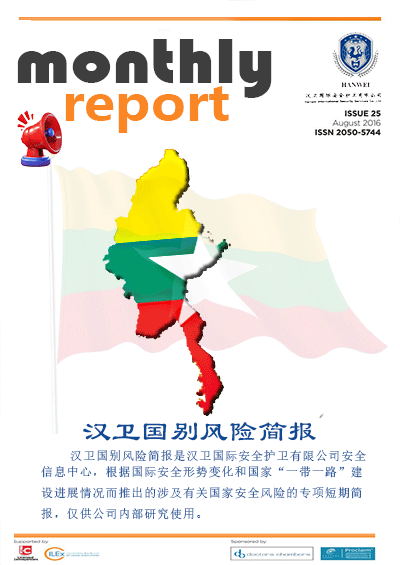
Myanmar Monthly Risk Report‑June 2026
According to security‑public‑opinion monitoring reports from Hanwei International, 161 representative security incidents across Myanmar were documented in June 2026, 11 fewer than July. These incidents caused 114 deaths and 166 injuries. Among recorded incident categories, armed conflicts and airstrikes predominated. Incidents were mainly concentrated in Rakhine State, Sagaing Region, Shan State and other areas.
In June 2026, Myanmar’s military‑backed government made important diplomatic progress. President Min Aung Hlaing completed a state visit to China and deepened practical bilateral cooperation across multiple fields. Militarily, the military kept scaling up airstrike operations. Rakhine State became the core combat zone, displacing large numbers of civilians. Economically, the government strove to stabilise the domestic financial environment, boosted support for micro, small and medium‑sized enterprises (MSMEs), and mapped out economic‑growth targets for the new fiscal year. In terms of social governance, efforts continued to crack down on cross‑border telecom fraud and drug‑related crimes. On June 30, the Union Parliament reviewed and assessed the State‑of‑Emergency Decree, completing preliminary legal preparations for its 90‑day extension in July.
Intensive Diplomatic Interactions and High‑Level Exchanges
From June 15 to 19, Myanmar President Min Aung Hlaing undertook a state visit to China, a major outbound state visit by Myanmar’s head of state following the country’s political shift. The heads of state of China and Myanmar held talks. The two sides reached broad consensus on multiple topics including joint development of the China‑Myanmar Economic Corridor, safety protection for Chinese personnel and projects in Myanmar, joint crackdowns on telecom‑network fraud and drug smuggling, and advancement of Myanmar’s peace and reconciliation process. They issued a joint statement on building a China‑Myanmar community with a shared future, and exchanged views on advancing key projects such as the Kyaukphyu Deep‑Water Port and the Muse‑Mandalay Railway. During the visit, Min Aung Hlaing also toured Shanghai, Hangzhou and other cities to learn from China’s experience in infrastructure and industrial development, and engaged in economic and trade exchanges with Chinese enterprises.
In late June, Myanmar stepped up engagement with ASEAN mechanisms to pave the way for its foreign minister to attend an in‑person ASEAN meeting, and actively sought to resume normal contacts with ASEAN member states. Myanmar and Thailand held preliminary consultations covering border security, cross‑border crime suppression and transport‑infrastructure upgrading, and made preparations for subsequent high‑level mutual visits.
Economic Pressures and Plans for Recovery
Inflationary pressures persisted across Myanmar in June. Cash shortages and restrictions on mobile‑payment accounts adversely affected people’s livelihoods and commerce. The government further strengthened support for MSMEs and pushed forward preparatory work for the MSME Development Fund, laying institutional groundwork for the disbursement of the 170‑billion‑kyat fund. Relevant authorities conducted economic projections for Fiscal Year 2026‑2027. They assessed that agriculture would remain the backbone of the national economy. With GDP growth standing at 1.9 % in the previous fiscal year, the government will target 3.4 % growth for the coming fiscal year. Rice exports will remain a core priority for agriculture, and phased export‑target proposals are under study.
On infrastructure, the government compiled a national list of bridge‑and‑road rehabilitation projects. Pre‑project appraisal got underway for the Kalemyo suspension‑bridge repair and the Mongkai‑Pankhtu‑Keshi highway‑widening scheme. Agricultural authorities deliberated pesticide‑control policies, studied the impacts of high‑risk pesticides on agricultural‑product safety, and carried out preliminary research supporting the ban on Thiamethoxam and Clothianidin.
Sustained China‑Myanmar People‑to‑People Exchanges
Multiple channels facilitated China‑Myanmar cultural and people‑to‑people exchanges in June. Chinese diplomatic missions in Myanmar publicised achievements of bilateral friendship and cooperation. Preparations moved ahead for the 2026 China‑Myanmar Media Twin‑City Forum and China‑Myanmar Cultural Exchange Week scheduled for Yangon in July. Coordination with media outlets, think‑tanks and cultural institutions from both sides advanced event plans covering forum sign‑off ceremonies, book‑translation releases, thematic exhibitions and bazaar performances. Media organisations of the two sides held multiple rounds of consultations on renewing framework agreements for content exchange and joint communication. Translation and proof‑reading for the Burmese‑language edition of Guwen Guanzhi (An Anthology of Ancient Prose) proceeded steadily.
Ongoing Warfare: Parallel Crackdowns on Fraud and Narcotics
The ongoing civil war further expanded the internally displaced‑population and aggravated the humanitarian crisis. Fighting in locations such as Kyaukphyu in Rakhine State forced over 50 000 residents to flee their homes, with severe shortages of staple supplies including food and tents. ACLED assessed that rainy‑season rainfall would partially constrain ground manoeuvres yet would not curb military airstrikes, keeping risks of civilian casualties and displacement at a high level.
For cross‑border‑crime governance, China, Myanmar and Thailand prepared for the Second Ministerial‑Level Anti‑Telecom‑Fraud Meeting. They reviewed outcomes of prior joint operations dismantling fraud compounds and analysed new trends among fraud hubs in Myawaddy, Three Pagodas Pass and elsewhere. Fraud groups have shifted toward remote mountainous border zones; some new dens are better concealed, and large numbers of foreign nationals remain trapped inside the compounds. Myanmar’s parliament began drafting and deliberating amendments to the Anti‑Online‑Fraud Law, considering severe penalties including the death penalty and life imprisonment, and planning to set up a dedicated national committee for combating online fraud.
On anti‑drug work, on June 26 (International Day against Drug Abuse and Illicit Trafficking), Myanmar held large‑scale public drug‑destruction ceremonies simultaneously in Yangon, Mandalay and Taunggyi. A total of 28 tons of narcotics including methamphetamine and heroin, valued at approximately USD 525 million, were incinerated, marking one of the largest such operations in recent years. Drug cases were cracked in multiple regions throughout the month, yielding large seizures of stimulant tablets and heroin. Border anti‑narcotics pressure remained high.
Battlefield Updates: In June, fierce clashes erupted between the Arakan Army (AA) and the Tatmadaw across multiple locations in Rakhine State. The military kept reinforcing troop deployments and launching airstrikes. An airstrike in Kyauktaut on June 17 inflicted civilian casualties including women and children. In Kyaukphyu Township, Rakhine State, the two sides fought repeatedly over naval outposts and key highway routes. Numerous villages were destroyed and mass civilian flight ensued. Conflicts also flared frequently in Sagaing Region, Chin State and Shan State. Ground combat was accompanied by artillery shelling and airstrikes; transport infrastructure sustained heavy damage, several road sections were closed and civilian traffic was cut off. An explosion at an explosives warehouse in northern Shan State caused heavy casualties and widespread property damage.
Natural‑Disaster Risks & Safety Reminders
June ushered in Myanmar’s rainy season, bringing heavy rainfall across many areas and rising risks of flash floods and landslides. Dykes and roads damaged in combat zones amplified humanitarian risks from secondary disasters.
Hanwei International Recommendations:
During the rainy season, avoid conflict‑affected and controlled zones as much as possible, stay away from mountain‑valley areas, and stock up on rain‑proof and disaster‑relief supplies.
Closely monitor meteorological alerts and conflict developments, keep communication devices functional, and stay clear of high‑risk zones threatened by explosions and airstrikes.
Do not travel to high‑risk border hubs for telecom fraud such as Myawaddy and Three Pagodas Pass. Remain alert to human‑smuggling traps and fraudulent high‑salary‑job offers.